What Is the Internet? Complete Beginner Guide
Understand what the internet really is, how devices connect globally, and the fundamental concepts behind modern web communication. A must-know foundation before learning web development.
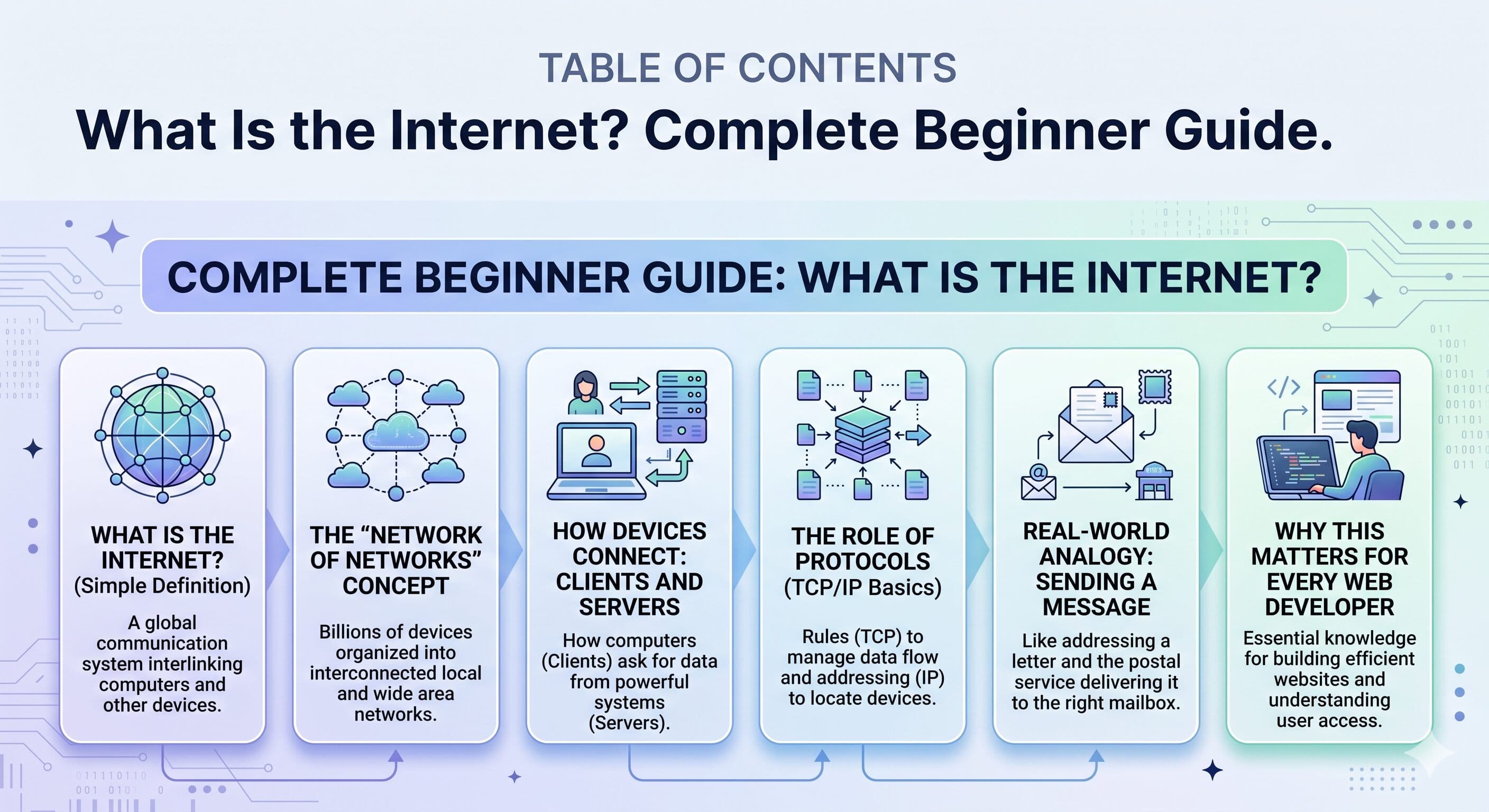
What is the Internet?
The internet is not a single big computer or a magic cloud in the sky.
It is simply a huge global network that connects billions of computers, phones, tablets, and servers so they can talk to each other.
Think of it as the world’s biggest postal system — except instead of letters, it carries emails, videos, websites, messages, and files at almost the speed of light.
Whenever you open YouTube, check your bank balance, or visit this website (aadityahasabnis.com), your device is using the internet to request information from another device somewhere in the world and get the answer back.
The “Network of Networks” Concept
The internet is not owned by one company.
It is a network of networks — thousands of smaller networks (your home Wi-Fi, your college network, a company’s internal network, data centers, mobile towers, etc.) all joined together.
This design makes the internet incredibly strong: if one path fails, data can automatically take another route. That is why the internet keeps working even during storms, cable cuts, or high traffic.
How Devices Connect: Clients and Servers
Every interaction on the internet happens between two roles:
- Client → The device you use (your laptop, phone, or tablet). It requests information.
- Server → A powerful computer (or group of computers) that stores websites, apps, videos, and data. It responds to requests.
Example: When you type aadityahasabnis.com in your browser:
- Your laptop (client) says, “Hey, please send me the homepage.”
- The server that hosts your website replies, “Here is the HTML, CSS, and JavaScript for the page.”
This back-and-forth is called the client-server model and it powers almost every website and app you use.
The Role of Protocols (TCP/IP Basics)
For two devices to understand each other, they need a common language. That language is called a protocol.
The two most important protocols are:
- IP (Internet Protocol) → Gives every device a unique address (like a phone number or postal address).
- TCP (Transmission Control Protocol) → Makes sure the data arrives correctly, in the right order, and without missing pieces.
Together they are called TCP/IP — the fundamental rules of the internet. Every website, email, and video you watch travels using these rules.
Real-World Analogy: Sending a Message
Imagine you want to send a birthday card to your friend in another city.
- You write the message and put it in an envelope (your data).
- You write the full address on the envelope (IP address).
- The post office breaks your card into smaller pieces if needed (packets).
- Each piece travels through different routes (routers and networks).
- The pieces are reassembled at the destination and your friend receives the complete card.
The internet works exactly the same way — only much faster and automatically.
Fun historical fact: The very first message ever sent on the internet (in 1969) was supposed to be “LOGIN”. The system crashed after the first two letters, so the first message that actually travelled across the network was simply “LO”.
Why This Matters for Every Web Developer
Understanding the internet is not just “nice to know” — it is essential.
When you build websites or apps, you are actually telling clients and servers how to talk to each other.
If you don’t understand the basics:
- You won’t know why your site is slow in some cities.
- You won’t understand errors like “DNS not found” or “Connection timed out”.
- You will struggle when you start working with APIs, databases, or deployment.
Once you grasp these fundamentals, everything else in web development (HTML, CSS, JavaScript, backend, full-stack) becomes much easier and more logical.
Quick Recap + Next Steps
- The internet is a global network of networks.
- Devices communicate using the client-server model.
- Data travels in packets following TCP/IP protocols.
- It functions like a super-fast postal system.
You now have the complete mental model of how the internet works.
Next Article in this subtopic: How the Internet Works Behind a Website (Step-by-Step) → We will see exactly what happens in the background the moment you type a URL and press Enter.
Comments
Thoughts, questions, and feedback.