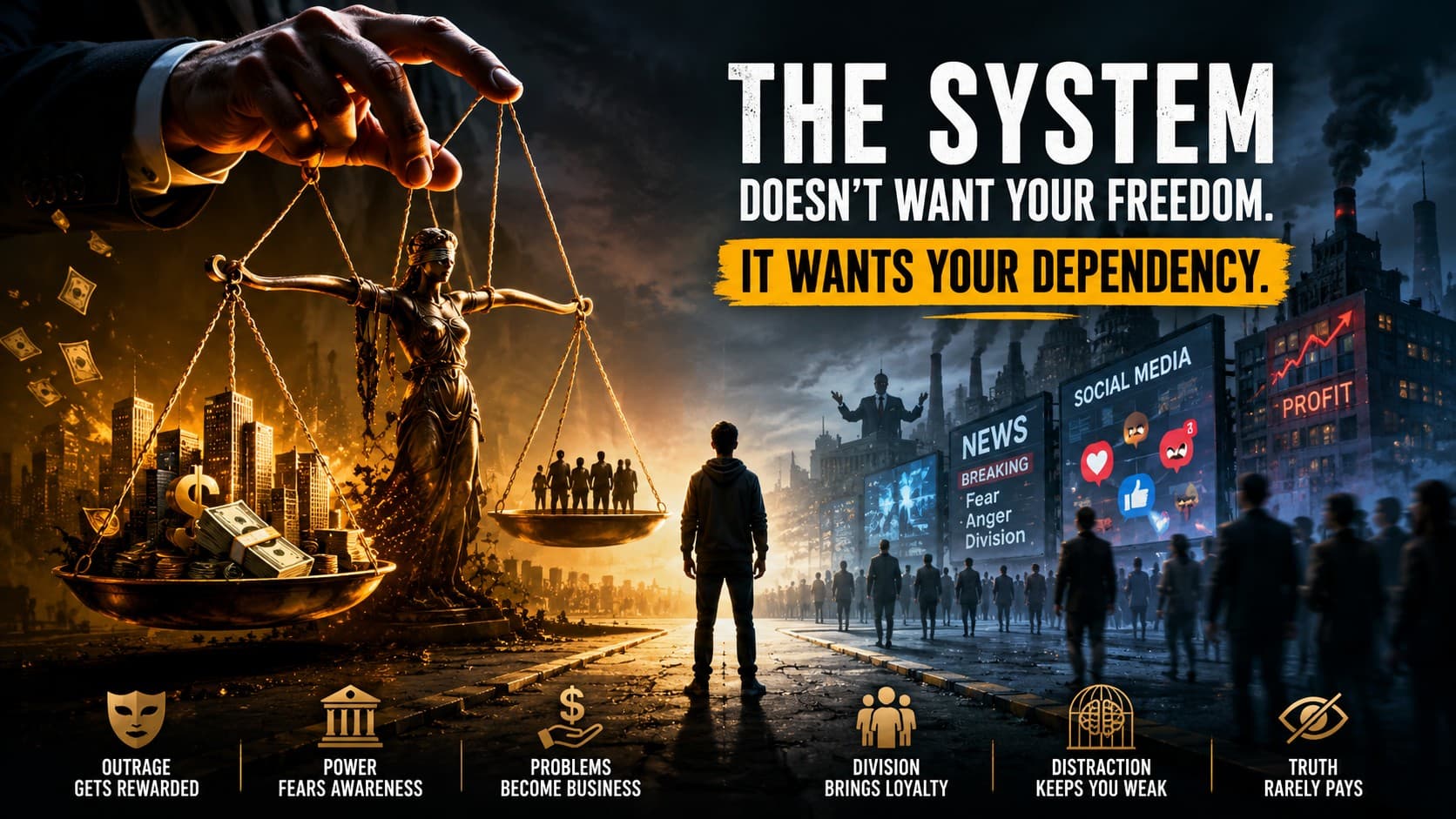
The Goat Never Wins: A System Built Against You
A powerful breakdown of the quote “A goat cannot win a case where the judge sells meat” — exploring how social media, politics, media, education, and modern systems often profit from fear, addiction, division, and dependency instead of solving problems.
Why Some Systems Were Never Designed to Be Fair
“A goat cannot win a case where the judge sells meat.”
This line is not really about a goat.
It is about systems controlled by people who profit from your suffering.
The goat enters the court expecting justice.
But the judge’s business survives because goats are slaughtered.
So the result is already decided.
The quote explains:
- conflict of interest
- power imbalance
- fake fairness
- controlled systems
- institutional hypocrisy
The deeper wisdom is:
Never expect true justice from people, platforms, institutions, or systems that earn from keeping you weak, dependent, divided, addicted, emotional, or exploited.
The Most Important Thing People Ignore: Incentives
Most people listen to words.
Smart people study incentives.
Because incentives reveal the truth faster than speeches ever will.
A company may say:
“We care about your mental health.”
But if their profits increase when you stay addicted, anxious, scrolling, and emotionally reactive…
then what do they truly serve?
A politician may promise unity.
But if division gives them votes, attention, power, and loyal supporters…
then conflict becomes valuable.
This is the core idea:
When someone benefits from your weakness, fairness becomes difficult.
Not impossible.
But difficult.
Social Media: The Perfect Modern Example
Social media platforms constantly talk about:
- community
- awareness
- freedom of expression
- mental health
But look at what the algorithm rewards.
Not calm discussion.
Not deep thinking.
Not balanced opinions.
It rewards:
- outrage
- controversy
- tribalism
- emotional reactions
- endless scrolling
Why?
Because emotional people stay online longer.
And attention is money.
The more angry, insecure, addicted, or reactive you become, the more profitable you are.
That’s why:
- fake news spreads faster than facts
- toxic debates get more reach
- drama trends faster than wisdom
The system says:
“Speak freely.”
But secretly rewards chaos.
The goat is allowed to speak in court.
That creates the illusion of fairness.
But the system profits from the noise, not the truth.
Politics: Division Is Profitable
Modern politics often functions less like leadership and more like audience management.
People are divided into:
- left vs right
- religion vs religion
- language vs language
- ideology vs ideology
Because emotional people are easier to mobilize than rational people.
Fear creates loyalty.
Anger creates engagement.
Conflict creates attention.
And attention creates power.
If citizens become:
- financially independent
- emotionally stable
- critically aware
- difficult to manipulate
many political strategies stop working.
So sometimes the system unconsciously rewards emotional dependency instead of empowerment.
The public believes they are participating in democracy.
But often, they are simply participating in emotionally engineered conflict.
Again:
the judge sells meat.
Corporate Culture: “We Are Family”
One of the most overused corporate lines is:
“We are family.”
But real families do not replace you because quarterly profits dropped.
Many companies genuinely care about employees.
But many systems also reward:
- overwork
- burnout
- unpaid emotional labor
- constant availability
- fear of being replaceable
An exhausted employee is often easier to control than a confident one.
People sacrifice:
- sleep
- relationships
- health
- identity
just to remain employable.
The company speaks about balance.
But rewards those who destroy theirs.
That contradiction is the modern workplace reality for millions.
The Education Industry: Fear as a Business Model
Education should build thinkers.
But many educational ecosystems build anxiety instead.
Students are trained to fear:
- failure
- low marks
- competition
- rejection
- “falling behind”
And fear creates one of the largest industries in the world.
More courses.
More coaching.
More certifications.
More subscriptions.
More pressure.
The student stops learning for curiosity.
They start learning for survival.
And the system profits from that fear.
The problem is not education itself.
The problem is when insecurity becomes the business model.
News Media: Fear Gets Higher TRP
A calm headline rarely goes viral.
Fear does.
That is why many media systems naturally drift toward:
- outrage
- panic
- sensationalism
- emotional framing
Because fear keeps viewers watching.
Conflict keeps audiences engaged.
Silence doesn’t sell.
Peace doesn’t trend.
A society constantly consuming fear eventually becomes emotionally exhausted — and easier to manipulate.
The media claims:
“We are informing the public.”
But sometimes the business model rewards emotional stimulation more than truth itself.
The Illusion of Choice
The most dangerous systems are not openly oppressive.
They don’t force you.
They entertain you.
Distract you.
Validate you.
Keep you emotionally occupied.
You feel free because you can speak.
But speaking is not the same as being heard.
You feel informed because content is everywhere.
But information overload often destroys real understanding.
You feel connected.
Yet loneliness is rising globally.
The illusion of participation is often enough to prevent rebellion.
That is why the goat is allowed inside the courtroom.
The system needs the appearance of fairness.
So What Should People Do?
This quote is not teaching paranoia.
It is teaching awareness.
The lesson is not:
“Trust nobody.”
The lesson is:
“Understand incentives before trusting systems.”
Ask difficult questions:
- Who profits from this?
- Does this system benefit when the problem continues?
- Is this platform helping me grow or keeping me dependent?
- Is this leader empowering people or emotionally controlling them?
- Is this information educating me or simply provoking me?
Critical thinking begins when you stop blindly consuming and start analyzing structures.
The Real Freedom Most People Never Reach
Real freedom is not only financial.
Real freedom is:
- emotional independence
- intellectual clarity
- the ability to think beyond manipulation
- the ability to disconnect from engineered outrage
- the ability to recognize when a system needs your weakness to survive
Because once you understand incentives, the world starts making sense.
You stop getting emotionally trapped by every headline.
You stop worshipping every influencer.
You stop believing every slogan.
You stop expecting justice from systems designed around profit, power, or control.
And most importantly:
You stop standing in the courtroom begging the butcher for mercy.
Final Thought
The quote survives because it exposes an uncomfortable truth about human systems:
Fairness becomes rare when power profits from suffering.
The world is full of institutions that speak the language of care while operating on the economics of dependency.
Some systems truly want to help you.
Others only want to manage you.
Wisdom is learning the difference before the verdict is already decided.
Comments
Thoughts, questions, and feedback.